Opening Exhibition: How much ‘hua’ do you feel today?
EXHIBITION DATES
2023.11.22 — 2023.12.22
LOCATION
72 Club St #01-01
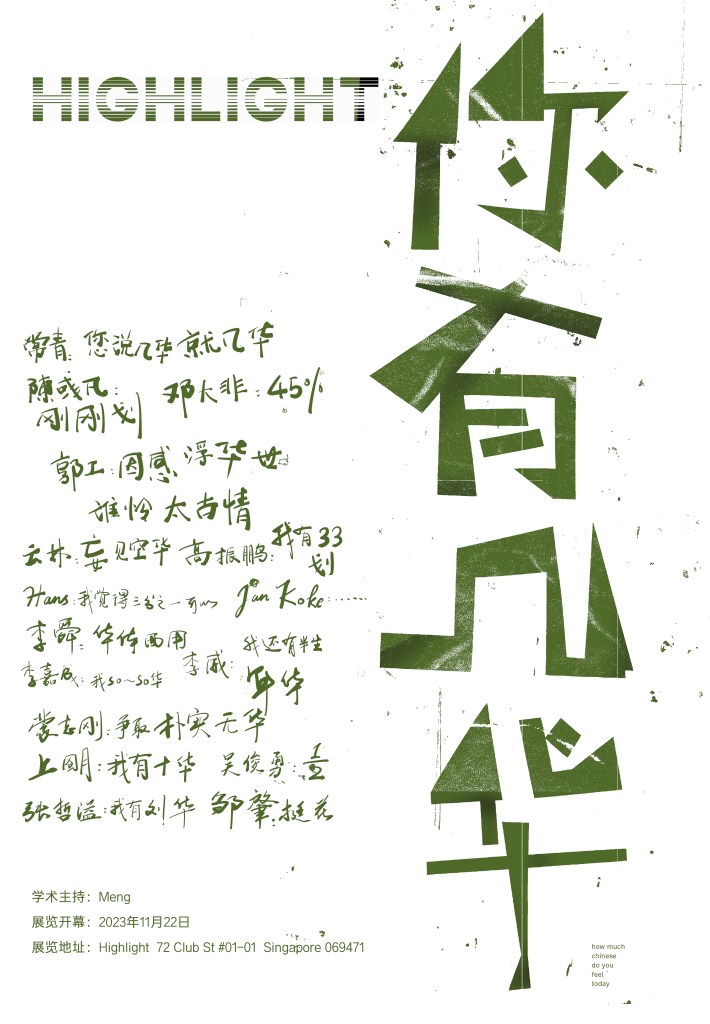
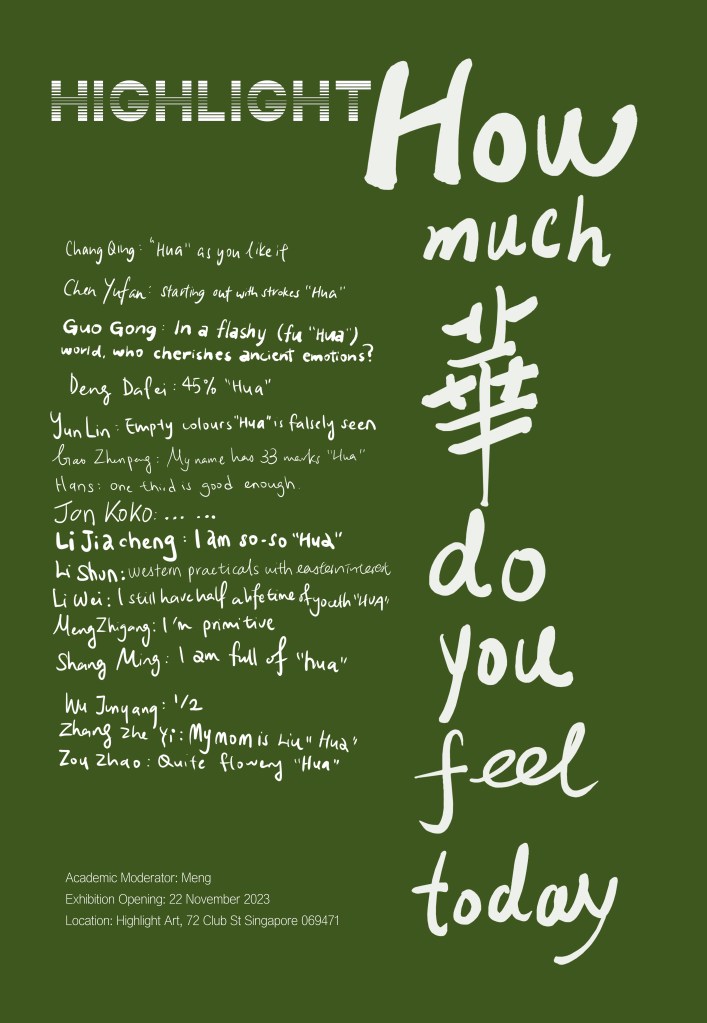
Highlight Art is delighted to announce the official opening of the “How much ‘hua’ do you feel today” group exhibition on November 22, 2023. This marks the first exhibition at Highlight Art’s new space on Club Street in Singapore. The exhibition’s theme explores various ways in which artists who employ an Eastern art style present contemporary art concepts from traditional art methods. Participating artists, through their captivating works, reexamine long-established cultural norms in diverse ways.
The division of human ethnic groups is based on the convergence and divergence of languages, followed by a person’s beliefs and regionality. The development, aggregation, and formation of a culture’s influence onto a civilization has historically followed certain laws and patterns. People of the same language groups tend to develop similar systems of logic and cultural habits. Today, the Chinese peoples dispersed around the world form a vast linguistic group with a complex and diverse cultural background. The contemporary art exhibition “How Much 华 Do You Feel Today” (“How Much Hua Do You Feel Today”) aims to present various artistic language experiments, actively pursued by Chinese artists from different historical backgrounds and cultural contexts.
The exhibition’s theme is a psychological ‘greeting’, simulated and refined from the daily lives of Southeast Asian Chinese artists, acting also as a process of verifying each other’s ancestral identity. Is “华” (Hua) a choice, an innate trait, or a label imposed by others? During the planning process, participating artists responded to the theme with rich emotions, actively adding multiple meanings to “华” (Hua). The Chinese character “华” (Hua), when translated into English, corresponds to an association with or belonging to China. At the same time, the Chinese have chosen this word to represent their race (after, of course, coming up with the idea of a Chinese race), possibly because of its more ancient and archaic meanings: glory, beauty, flowers, and greatness.
While these artists differ significantly in materials, scale, and tone, the exhibited works convey similarities, elucidating common points of inspiration, whether impassioned or refined, enthusiastic or rigorous, personal or from a grand narrative.
The exhibition “How much 华 do you feel today?” aims to expand people’s understanding of their own cultural identity, and, within this new chapter of history, continues to chase the answers to: “Who am I?” and “Who will I become?”
Our participating artists include:
Guo Gong, based in Beijing, China. The artist excels in analysing the physical properties of materials from a unique perspective during the creative process. Using a manner of artistic logic, he transforms said materials into entities that inhabit paradoxical landscapes. In the conflicts expressed within the materials themselves, he succinctly conveys the speculative abilities of the artist. Although he doesn’t frequently interpret his own works through scholarly and literary Eastern contexts, the artist quotes a poem by Li Zhong from the Tang Dynasty to respond to the question posed in the exhibition: “因感浮华世,谁怜太古情” (“Amidst this fleeting world / Who pities ancient sentiments”)
Chang Qing, based in Hangzhou, China. Chang liberates his art with free-spirited brushwork, a departure from more classical constraints. Transitioning from meticulous still lifes to a serene stance based on literati traditions, he combines solemnity with unbridled expression. His recent works evoke a calculated playfulness, encapsulated in his response to the titular question of the exhibition – “你说几华就几华” (“as much as you like it to be”) Chang Qing masterfully navigates the interplay between precision and a lack of restraint, creating a work where both the profound and playful engage in harmonious dialogue.
Chen Yufan, based in Hangzhou, is an artist with roots in Putian, China. His works seamlessly embody the mathematical and aesthetic rhythms unique to the city’s maritime cultural group. The artistic prowess bestowed by Mazu, the Chinese sea goddess, and Southern Chan Buddhism finds eloquent expression in Chen Yufan’s paintings and sculptures. The “衍生物” (“Derivatives”) series serves both as paintings and performative installations, where pigments flow in diverse directions, interweaving with the four junctions of the painting’s frames, collectively inducing subtle spatial transformations. The repetitively singular act of painting, in a manner akin to the act of selfless meditation, approaches the introspective approaches emphasized in Zen philosophy. Therefore, in response to the exhibition theme, the artist answers with a swift “stroke.”
Shang Ming, in his early years, underwent spiritual practice in Nanyang temples. After departure from Singapore and upon returning to his hometown, he engaged in the practice of calligraphy and painting alongside his pursuits towards Zen, cultivating his mind amidst the wonders of nature. His paintings exude a pure and untamed charm, transcending the mundane with sublime elegance, distinctly different from academic styles of traditional ink painting. Today, Shang Ming is an extraordinary plein air artist, embodying a realm of “coolness,” a carefree ink-wielder, semi-concealed amid the peaks of Yandang Mountain, whether in monastic or secular guise, subject wholly to the dictates of the world.
Zhang Zheyi, based in Beijing, China/ New York, USA. In recent years, the artist is focused on exploring the abstract relationship between humanity and nature, in relation to Eastern aesthetics. His works often feature motifs such as lightning, ice cracks, and polar icebergs, a new attempt to depict the tangible world and a journey of abstract speculation. The piece “Floating Ice” 《浮冰》 captures the artist’s perception of natural geometric landscapes, with corners of the frame intentionally omitted, serving as unique windows to the world behind and external to the artwork. The artist frequently uses double entendres to connect cultural references between different worlds. The work “Pyrrhon” alludes to the famous Greek skeptic philosopher Pyrrho, known for his ideas to “Make no decision, suspend judgment” and that “Things are distinct, unpredictable, and indeterminable.” Simultaneously, “Pyrrhon” also refers to an ancient Chinese historical case, where Wang Anshi stated, “The skin of water forms waves.” Su Dongpo responded, “If that’s true, then the bones of water would be slippery.” The Western philosopher Pyrrho maintaining his “tranquility” beneath the sea aligns with the Chinese philosopher Wang Yangming’s concept of “constant centering.” Eastern and Western myths, philosophies, and cultural anecdotes often overlap, but the interpretation of “Pyrrhon” extends far beyond these parallels. The artist best understands “universal love,” and when asked to respond to this exhibition, his response is, “I have Liu Hua,” signifying that his mother is the epitome of the “world.”
Meng Zhigang, based in Shanghai, China/Singapore. In his recent work, 《山河水》 “Mountains and Rivers,” the artist interprets the meaning of “landscapes” through the lens of a wartime helmet adorned with “dry landscape” imagery. From one perspective, the landscape represents a wilderness, akin to the journey by Moses leading his people out of Egypt. From another angle, the mountains and rivers symbolise the Daoist realm, where ancient paintings often depict mountain ranges surrounding an imperial peak where blank spaces suggest the presence of a hidden dragon. Whereas, mountains, rivers, and waterways are closely tied to the Chinese concept of sacrificing for nation. The external landscapes serve as a means to temper one’s will, experience hardships, gain insight into reality, such is the basis of discussion for this piece of art. The artist, devoid of nostalgia, responds to this curatorial prompt by stating: simple and unadorned.
Deng Dafei, Beijing, China. Deng is a typical artist from the intellectual generation of the 1970s. His artistic thinking is rigorous yet highly open-minded, allowing him to continuously explore new humanistic clues and linguistic paths in contemporary art. He holds a 45% affirmation value for his own metaphysics. In his exhibition, Dafei virtualises a missionary named Li Yage, using various mediums such as documentaries, antique imitations, prints, etc., to verify the missionary’s real existence and extraordinary family history. Fictional history is also a part of human history, a truth historians can attest to, and artists can equally affirm.
Wu Junyong, based in Hangzhou. Born in Putian, Fujian, China, the artist’s work is imbued with the charm of mountains and wild landscapes, reminiscent of the tales from “Liaozhai.” This embodies a distinctive temperament within the tradition of classical Chinese literature. In contemporary ink painting, there is a rare ancient charm, which is precisely the faint immortal spirit from folk traditions. The manifestation of this spirit requires the blessing of a critical consciousness to illuminate the right path in the mortal world. Wu’s on-site paper work “Tianmu” and animated piece “Moon Rising” use whimsical approaches to articulate that authentic energy from traditional cultural heritage. This can be considered the “1” in the “1/2” that is from the artist towards the prompt.
Li Wei, based in Hong Kong. Li Wei’s recent experimental animated calligraphy works increasingly reveals her immersion in traditional cultural contexts. The artistic maturity and accumulation of knowledge from the post-70s and 80s era are notably evident in her work. Logograms are the core symbols of Chinese culture and the inherent foundation of the logical reasoning ingrained in the Chinese mindset. Li Wei uses modern digital tools to analyse and interpret the origins and allusions of seal script, constructing contemporary attributes for Chinese characters based on the emotions and sentiments of modern individuals. Connecting life, work, and beliefs into an elegant life scenario, Li Wei explores the art theme of “Half a Lifetime” with warmth and uniqueness.
Ding Sukai, known as Yunlin, is based in Beijing, China. In the years when the artist transitioned from oil painting to traditional paper-based creations, he also immersed himself in martial arts. The core values of China’s literary and martial traditions are rooted in the wisdom of Confucianism, Buddhism, and Daoism. Only those who can navigate across realms can find freedom, and this is the case for Yunlin. He admires the walking style of the famous Chinese traveler Xu Xiake. Throughout the year, Yunlin spends half of his time exploring mountains and rivers, while the other half is devoted to wielding brush and ink at his desk. His works draw inspiration from classical literati anecdotes and his current travel experiences. With a dual language of traditional brushwork and a contemporary POP spirit, the artist seamlessly switches between emotional dimensions, allowing viewers to momentarily detach from reality and together appreciate the concept of “illusory views and empty flowers.”
Li Shun, based in Hangzhou, China. During the recent period of collective confinement experienced by people worldwide due to the pandemic, the artist was inspired to use the traditional literati concept of “wandering in seclusion” to conduct remote sketching on the internet. He combines his creative motivation with historical allusions, literature, and photography concepts. His works exhibit logical order and novel materials. In response to the exhibition theme “Chinese Form, Western Application,” Li Shun’s art, under various critical interpretations, reveals a sincere and youthful heart.
Gao Zhenpeng, Beijing/Shanghai, China. A unique artist who is also a researcher, Gao Zhenpeng is a synthesizer of street culture. He employs various forms such as animation, rap, MTV, and mechanical paper-cut installations to create his interpretation of the real and unreal worlds. His work “Forging Dreams Here” features content captured and sampled from major landmarks in Shanghai. The artist reorganises them into colossal figures in the digital realm, endowing them with the power and personality of dominant tigers. In the anthropomorphisation of the rapid development of modern urbanisation, the artist releases the overpowering and mysterious aura of the “Magic City,” while also reflecting on the meaning of civilisation. “I have 33 strokes” – the artist’s response to ‘Hua’ is the number of strokes in his own name.
Zou Zhao, based in New York, USA and Singapore, focuses on performance art using mediums like live performances, videos, and writing. She delves into “Chinese media,” exploring information with ‘transmission’ meaning through a process of ‘misjudgment,’ ‘misinterpretation,’ and ‘misunderstanding.’ Her past works reveal intriguing contradictions and reflect the political climate at different times. Zou Zhao guides audiences in analyzing suppressed desires in contemporary society due to historical wounds. In this exhibition, she interprets a Southeast Asian cultural “colonial formula” by extracting and refining “artistic ingredients” and maritime elements in a guided on-site art piece. Her succinct response, “I am very floral,” alludes to the shared pronunciation of “花” (huā) with “华” (huá), signifying splendor or brilliance in Chinese characters.
Hans Chew, based in Japan/Singapore. “Street Court” is an art concept created by the artist during his studies in Japan, inspired by various interesting experiences in urban living. Although the shapes appear abstract, careful observation reveals prototypes of life scenes such as houses, trees, surveillance cameras, and inexplicable creatures. Art originates from life but often transcends the boundaries of reality, presenting marvelous results. Starting with his grandparents’ migration to Southeast Asia, Chew considers himself one-third Chinese in this third generation of his family.
Jon Koko, based in Japan/Switzerland. His works are subtle in colour, characterised by simple compositions and a strong Zen aesthetic. As a Westerner, the artist has spent an extended period living in East Asia. His tranquil inner cultivation brings a serene and perfect personal landscape to the present world.
 Highlight Art