
Fierce Divine Journey
EXHIBITION DATES
2023.10.13 — 2023.10.17
LOCATION
72 Club St #01-01
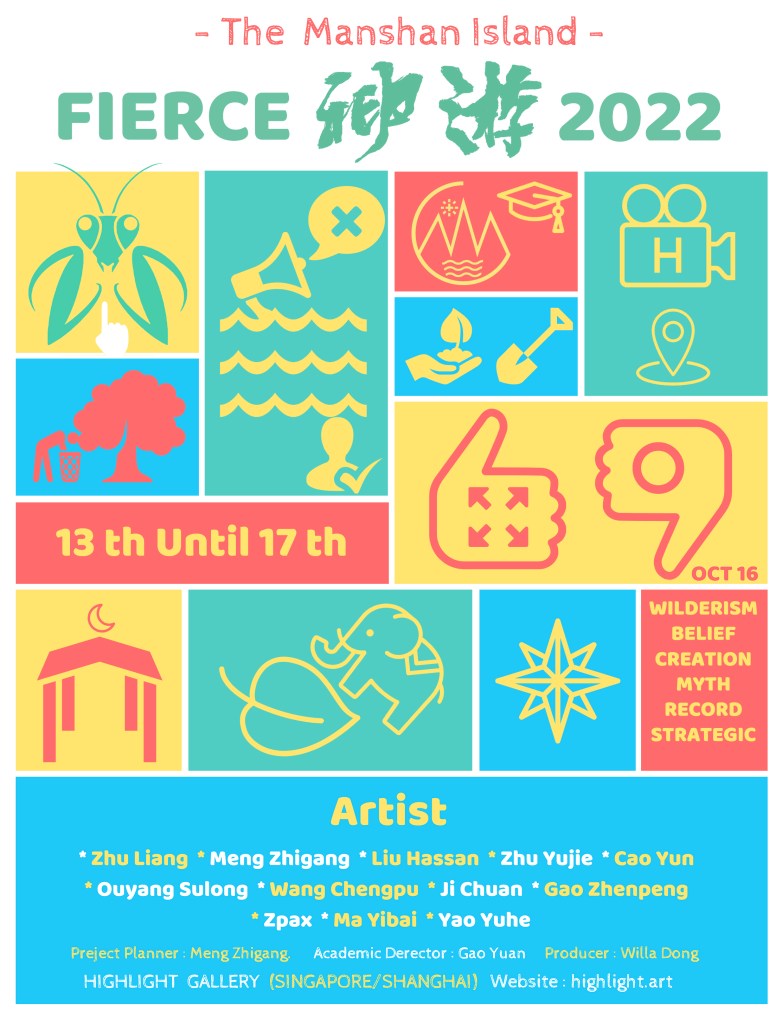
The artistic community in the Indo-Pacific region engages in artistic language refinement and experimentation through nomadic creation. It attempts to use the logic of “mythology,” one of the origins of civilization, as a clue to rediscover and even invent a localized artistic “elemental” language.
Artistic Concepts:
1 We generally think that literary and artistic content related to “landscape” is unique to Chinese culture. However, Christian culture also has theories about landscapes. Regardless of the East or West, the origins of early landscape concepts are closely related to religion and belief. In Eastern art, specifically in paintings and poems centered around “landscape,” the revered aesthetic realm is Taoist. Various poetic expressions in traditional painting critiques were reconstructed mental landscapes based on Taoist aesthetic standards. This is similar for poems like “You Xian” and the Zen poems that emerged after the Tang Dynasty. The concept of “Zen” in Buddhism is itself a Chinese-style Buddhism that integrates Taoist sentiment. Hence, the “Zen spirit” in artistic expression is 50% Taoist sentiment, eventually converging into the concept of “harmony between man and nature.”
2 The Christian aesthetic of landscapes focuses on the concept of the wilderness. Modern American culture still retains the wilderness lifestyle, which slightly opposes or reflects upon the rise of industrial civilization. The existence of U.S. wilderness preserves is connected to the acknowledgment of this ecological civilization. In these areas, there’s no cellphone signal, and even basic human-made facilities can’t be built to maintain the original state of the land surface. When modern humans enter such places, the most immediate feeling left is the connection between heaven and earth, and the divine and humanity.
Different from the Eastern landscape art tradition, the Christian context of wilderness ideology is closely linked to their modernist poetry and art. It was during the era of the “Beat Generation” in the U.S. that Snyder, inspired by the Zen poems of Han Shan in China, saw modernist free verse and Emersonian naturalism in the wilderness. Snyder also wrote Zen poems, thus resulting in a collision and chemical reaction between these two forms of landscape charm in a specific era.
Purpose of Artistic Action:
The artist community immerses itself in natural environments or wilderness, returning to the original experience of humans in the natural world. While collecting stories from the heavens and the earth, they explore ancient myths or create allegories for the new era. Between heaven and earth, they express their emotions and jointly excavate the foundational language of art. They continue to reconstruct or create the genetic code of cultural context, investigating new clues for our contemporary and future artistic language.
The creative process of this art project will fully utilize the public and communicative nature of video art in this era. It aims to establish a new mode of curation and artist collaboration. It treats experimental imagery as a crucial medium in the artistic process and uses practical actions to embody adventurous art.
Project Planner: Meng Zhi Gang
Academic Director: Gao Yuan
Producer: Willa Dong
Artists:
Zhu Liang
Meng Zhi Gang
Liu Hassan
Zhu Yu Jie
Cao Yun
Ouyang Sulong
Wang Cheng Pu
Ji Chuan
Gao Zhenpeng
Zpax
Ma Yibai
Yao Yuhe
Art Implementation Locations:
First Phase (2022): Suzhou Taihu Lake region and related gardens
Second Phase (2023): Singapore
Indo-Pacific Region and other parts of the world
Artists Team: Meng Zhigang (China), Zou Zhao (Singapore), Li Jiacheng (Singapore), Hans(Singapore) etc.
Artistic Output: Experimental videos (art installations) not exceeding 15 minutes.
Producing Institution: HIGHLIGHT ART Singapore
 Highlight Art