
Durian Adoring Durian: xi hua Solo Exhibition

EXHIBITION DATES
2024.5.29 — 2024.8.09
LOCATION
72 Club St #01-01
Xi Hua Solo Exhibition in Singapore HIGHLIGHT ART
In June 2024, the first wave of flooding during the Jiachen year began spreading from Guilin, a city in southern China. A flood peak not seen in seventy years transformed the normally ethereal landscape of the Lijiang River into a powerful and destructive force. Tang Dynasty literati Ren Hua once described Guilin’s scenery in his work “Preface to Sending Off Judge Zong to Huatai,” writing, “The frost sweeps the sky, leaning towards the red cliffs. With pointed mountains rising from the flatlands, black as iron and sharp as a pen’s tip. There are the Yangjiang and Guijiang rivers, bypassing the military town and flowing south, gushing into the sea, submerging three mountains. How could the officials in the capital know of such landscapes in distant lands? Such are the landscapes, so are the people… Forgetting oneself is possible, but forgetting these mountains and rivers is not!” This may be one of the earliest accounts of the fierce side of Guilin’s landscape.

“Folded Landscape” Oil on Canvas 40x67cm, 2018
A place blessed with natural beauty and talented people, such is Guilin and its inhabitants.
Xi Hua, an artist from Guilin, Guangxi, began focusing on contemporary art around 1990. Starting with experimental ink paintings, he gradually ventured into installation art and comprehensive easel painting. At that time, Chinese contemporary art, known as avant-garde art, was developing with Beijing as the center for artists. In contrast, Guangxi was a remote region, and avant-garde art was still a non-mainstream phenomenon in China. Xi Hua’s artistic career began in a marginalized position, akin to his unique studio located in the mountains outside the city.

The overall view of Xi Hua Studio from a bird’s-eye perspective.
This cylindrical building, over twenty meters high, was originally an industrial water tower abandoned by an old state-owned enterprise. Over a decade, Xi Hua transformed it into a multi-level studio space with a staggered internal structure. Each ascent up the narrow, steep ladders clinging to the curved walls is a thrilling experience. The artist, working daily across these levels, found the studio a source of both visual and physical challenge. The studio, resembling both a high-altitude casting workshop and an art museum, houses various series of Xi Hua’s sculptures, installations, and paintings.

Renowned curator Feng Boyi and assistant curator Yang Qing visited Xi Hua Studio.
Unlike the early themes of Chinese contemporary art, such as Political Pop, Gaudy Art, and deconstructive explorations of traditional aesthetics, Xi Hua’s creations have always focused on very specific life experiences around him. He collects various industrial relics and curious materials, cutting and reassembling them according to his inspiration.
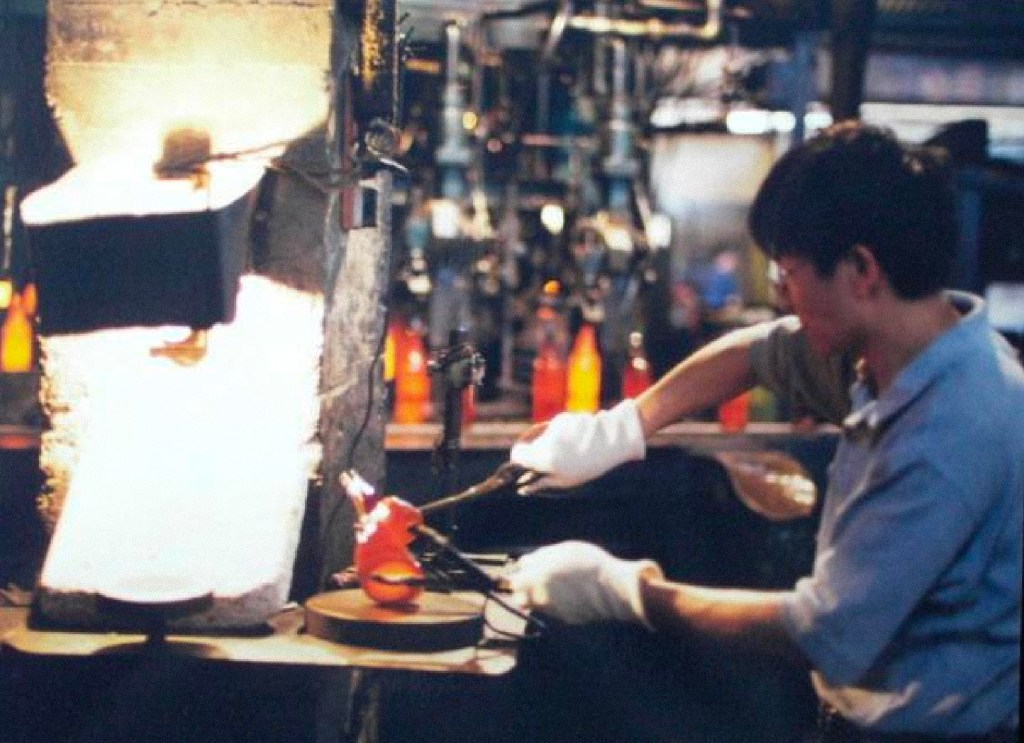
Xi Hua at the creation site of the “Wine Bottle Series” in the 1990s.
Bravely forging ahead, Xi Hua uses a pure perspective to examine the battle between nature and urbanization. His scholarly appearance belies his ability to handle the giant logs and steel materials in his indoor and outdoor workspaces. His personality, like the surrounding Diecai Finagling (Folded Brocade Hill), seems gentle and refined on one side but robust and formidable on the other.

The exterior of Xi Hua Studio.
The artistic climate in China has always varied between the north and the south. In the contemporary art scene, initial clusters of artists gathered predominantly in Beijing, where the artistic language and themes were mainly centered around political symbols and satire of mainstream societal contexts, similar to the “rogue” style explored by contemporary writer Wang Shuo in the literary field.
In contrast, contemporary art in the southern regions does not have a specific core community. South of the Yangtze River, the humanistic fabric has always been intricate and diverse, with a history of fantastical literary and artistic styles. In the inland provinces of Yunnan, Guizhou, and Sichuan, after the cooling of the modern realist painting trend influenced by scar literature, a new era brought forth a wave of sensual contemporary art, characterized by a strong sense of “locality.” This may be related to the high proportion of ethnic minorities in these regions, which has helped preserve a rich and primitive innocence in the local culture.
The coastal provinces, on the other hand, exhibit prominent maritime cultural characteristics and frequent interactions with foreign cultures. Shanghai, located at the mouth of the Yangtze River Delta, was an international center in Asia during the 1920s and 1930s. In the field of art, it inherited the modernist and abstract elite traditions from the Republic of China era. Several later accomplished artists transitioned from abstraction to contemporary contexts through symbolic pathways.

“Landscape with Sofa” Acrylic on Canvas with Ink. 130x390cm,2012—2020
Further south, in the Fujian and Guangdong regions, the evolution of painting styles extended to Southeast Asia. During the modernist transition, the art styles fluctuated, incorporating not only oil paintings and Impressionist depictions of flora and fauna influenced by traditional ink painting but also experimental fields influenced by international trends, such as Xiamen Dada.
The genesis of contemporary art in Guangxi initially featured a semi-abstract modernist style that distilled ancient rock paintings for the international market. This was followed by artists who embraced the “political pop” and kitsch styles, similar to their counterparts who migrated to Beijing. Distinct from these trends, Guangxi artist Xi Hua, from the outset, imbued his work with a subtle aesthetic remnant of the Cold War period, an aspect often overlooked by others.
Cold War aesthetics involved the formalization, design, and artistic transformation of scientism. It was an urban cultural process that used fashion and popular elements to dissolve the oppressive atmosphere of the Cold War. This was a phenomenon of the last century when the US and the Soviet Union’s competition in the space race extended to their light industries and citizens’ lifestyles. Eventually, this aesthetic concept spread and influenced the mainstream aesthetics or daily life in other countries within these two blocs. Reflecting on the 1960s and 1970s, this aesthetic was prevalent in fashion, appliance design, and film industries worldwide. Chinese artists who grew up in the 1970s and earlier shared a genuine emotional connection to this aesthetic, though this aspect has been largely overlooked in contemporary times. As a visual experience of the era, the later art market did not accurately reflect the intrinsic characteristics of that generation of artists. Instead, the field of film and television emerged as a significant medium, allowing the scientific formalist aesthetics accumulated during the Cold War to shine in science fiction movies and novels, achieving remarkable success and gaining international recognition.
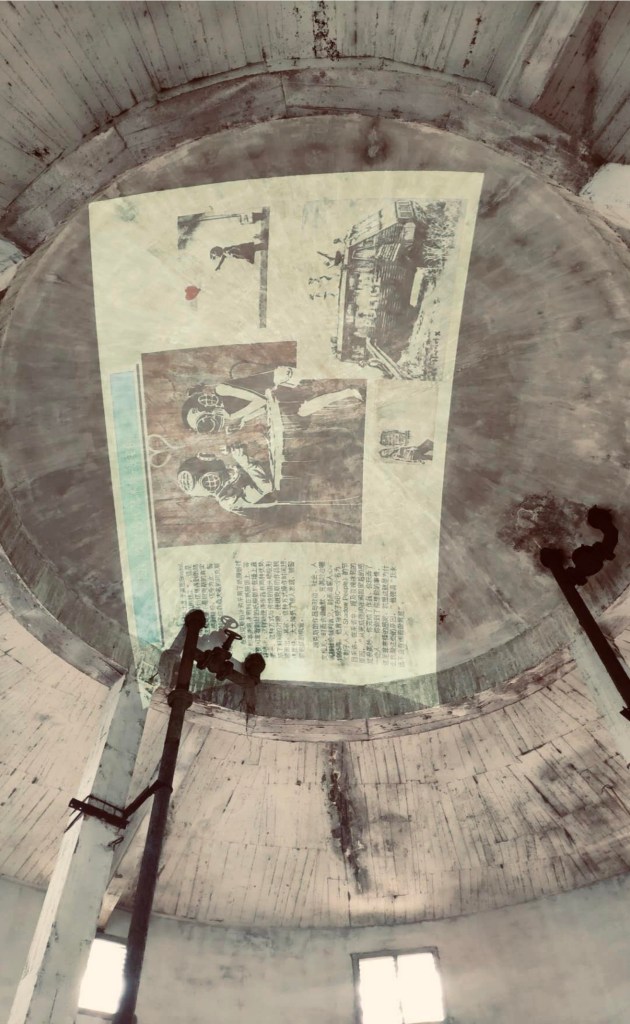
Xi Hua uses dome projection to analyze contemporary art.
Forty years ago, at the dawn of the Reform and Opening-Up era, the spirit of national modernization and prosperity swiftly replaced the long-standing period of stagnation.
The utopian ideals brought by the scientific outlook on development was soon transformed into a mechanical and sci-fi aesthetic that deeply resonated with the artistic youth of that time. The Cold War era’s “space race” imagination was ultimately absorbed into popular culture, becoming a genuinely local form of “pop art” accepted by the masses. This aesthetic imprint was particularly prominent among the artistic youth in southern Chinese cities, largely due to their early exposure to overseas imagery, cartoons, and other popular culture.
In early 1980s Guilin, Guangxi, streets and alleys were often frequented by long-haired hippie tourists from Europe and America on bicycles, reflecting an increasing exchange of popular culture. In 1980, when a Disney tour group visited Guilin, a professional cartoonist demonstrated the drawing of Donald Duck and Mickey Mouse to children at Qixing Kindergarten—characters that had not yet been introduced domestically.
Unlike Beijing, which hosted a significant number of long-term international diplomats, southern cities primarily saw foreign visitors as transient tourists. These international figures were among the initial observers of contemporary Chinese art, and the rise of the Chinese art market around 2000 was closely related to their influence.
Foreign international figures were among the initial audience for contemporary Chinese art, and the rise of the Chinese art market around 2000 was closely related to them. The differences in the audience of the art market led to different creative motivations. Southern art groups were less likely to produce post-colonial contemporary art such as “political pop,” largely because the Chinese art market’s “political pop” was, to a great extent, a form of “Far East” art mass-produced to cater to the tastes of foreign collectors in Beijing.


“Durian, Adoring, Durian” Exhibition Site / HIGHLIGHT / Highlight Art / Singapore.
The value of artistic creation lies in its unique language and the sense of novelty it introduces. An artist’s creative logic is closely tied to their daily environment and experiences. More than once, while accompanying Western friends on tours of the Guilin landscape, I’ve heard them exclaim that what they see before them is precisely the “China” they had imagined before coming: the misty, verdant mountains, the ethereal fishing boats and fishermen, a surreal scene of green wilderness. The image of Guilin’s landscape, with its mystical qualities, is often incorporated by creators from around the world into their own cultural visions to present an exotic Eastern style.
For example, in the epic sci-fi series “Star Wars,” the Jedi Master Yoda’s secluded sanctuary in the prequel “Revenge of the Sith” is modeled after the battle scenes of Guilin’s landscape. Japanese manga master Akira Toriyama also visited China for the first time in the 1980s, and later created the famous manga “Dragon Ball,” where the background elements of the protagonist Goku’s hometown are unmistakably inspired by the scenery of the Lijiang River in Guilin.

“Space Series: Drifting” Oil on Canvas 155x155cm/ 2013
Art serves as a snapshot of an era, facilitating cross-cultural exchanges and projections. When Guilin’s landscapes merge symbolically into other cultures, the resulting imagery also mirrors and blends into our visual experience, just like the overlapping images of “Star Wars” and “Guilin scenery.” Artists are the original intermediaries facilitating these visual exchanges, consciously or unconsciously, as Xi Hua’s creations do. Born in Guilin, he did not conform to popular aesthetics or local commercial art but instead freely transitioned between the aesthetics of natural landscapes and space battles, connecting his hometown with the world from an international perspective.
The significant changes in the 1990s ushered in the era of globalization, and smoother international exchanges accelerated China’s modernization process. The constant emergence of new things continually inspired and influenced the creative community. The anticipation of future technology and the local beauty of mountains and rivers led Xi Hua to encounter a cyberpunk-like vision of a new world. His youthful affinity for the aesthetics of technology and industrial machinery transformed into a concern for natural environments and the process of urban expansion. Romantic, tragic, and passionate fantasies filled Xi Hua’s sculptures and large-scale canvas paintings of that period with utopian imagination, naturally revealing his inherent humanistic care. Works such as the large-scale ink paintings “Astronaut” and “Elephant Man,” as well as the series “Alien” created in 2013, reflect this. The artist seems like a secluded figure from a futuristic time and space, continually exploring cyber technology and humanistic themes in picturesque secret realms.


HIGHLIGHT / Highlight Art / Singapore.
Romantic, tragic, and passionate fantasies filled Xi Hua’s sculptures and large-scale canvas paintings of that period with utopian imagination, naturally revealing his inherent humanistic care. Works such as the large-scale ink paintings “Astronaut” and “Elephant Man,” as well as the series “Alien” created in 2013, reflect this. The artist seems like a secluded figure from a futuristic time and space, continually exploring cyber technology and humanistic themes in picturesque secret realms.

Acrylic and Ink on Canvas Artwork “Astronaut” (Left),310x136cm,
“Elephant Man” (Right) 380x133cm,2013
Viewed in isolation, the contemporary art scene in the border region of Guangxi is indeed peculiar. However, when assessed on the timeline of globalization, such phenomena are not surprising. Since 1978, Guilin has opened up to the world. Before the 1990s, as one of China’s top three cities with the most foreign visitors (the other two being Beijing and Xi’an), local artists had early access to international visual experiences and pop culture symbols. Thus, in such a place, the visual symbols created by artists are infused with a futuristic aura, reflecting the genuine integration of China’s broader environment with the outside world during that era.
Guilin, as a unique geographical node, has seen similar artistic cases and talents not only in the field of painting but also in literature and independent music. However, given China’s vast territory, if these emerging talents do not enter the mainstream, they are easily overlooked and forgotten. The diversity of regional cultures being overshadowed by the broader environment is a disheartening trend in the contemporary art world and warrants deeper study. This is akin to how the disappearance of dialects leads to the decline of “local” literature. If there were no regional dialect differences, we wouldn’t have literary giants with such strong regional linguistic characteristics as Mo Yan, Jia Pingwa, and Wang Shuo. The value of differences in artistic language is similar.

Xi Hua’s hand-drawn works on paper in Soviet-era books.

“Twin Arch Bridge”. Oil on Canvas 155x155cm, 2018
Xi Hua’s personal art reflects his imagination and relaxation, influenced by his international city life. His daily routines in a picturesque setting among a world community help shape his unrestrained artistic style: ink on industrial canvas, graffiti on foreign books, and end-of-the-world cityscapes. His works effortlessly blend Eastern and Western sentiments through various forms such as installations and paintings.
Artistic endeavors are a dialogue between the individual and the external world, a beautiful cross-cultural exchange. Beyond Cold War aesthetics, Xi Hua keenly observes the details of life around him, painting glass railings, soup dumplings on kitchen boards, and clawing fruits like in his works “Folded Landscape,” “Café Railings,” and “Dragon Fruit” on cardboard, displaying his passion for life on the canvas.


“Durian, Adoring, Durian” Exhibition Site / HIGHLIGHT / Highlight Art / Singapore.
Around 2022, Xi Hua suddenly became interested in durian, a fruit unique to Southeast Asia. During an art residency in Southeast Asia, the enthusiastic crowds, rich natural resources, and the vibrant and inclusive multi-ethnic culture allowed Xi Hua to experience the local customs on the other side of the ocean. The exotic charm of the region led him to focus on this particular fruit and inspired a new theme in his work. The artist described, “With its prominent appearance and strong smell, those who like it can’t forget it and are reluctant to put it down; those who dislike it avoid it with their noses covered and try to keep away! Durian is such a contradictory entity that evokes both love and hatred.”
He further stated, “Southeast Asia, where durian is abundant, is an active region on the world economic map. Whether in terms of geopolitical relations, economic exchanges, national relationships, or even migration, there are various intertwined connections between countries and regions. Among all fruits, durian is the king, with its natural sharp angles and strong flavor; its rough skin and rich taste evoke a mixture of admiration and aversion far and wide. Using the name ‘durian’ to discuss ‘Southeast Asia’ is the initial inspiration behind the Durian series!”

“Durian, Adoring, Durian” Exhibition Site
The richness of civilization lies in the diversity at the world’s center. Guangxi, located on the edge of traditional Confucian civilization, is a significant cultural hub in the broader Southeast Asian region, particularly as a center for the Yao, Zhuang, and Dai ethnic groups. Contemporary Guangxi’s regional cohesion is becoming increasingly important. Leveraging the annual ASEAN Expo’s influence, recent years have seen a growing number of contemporary Southeast Asian art exhibitions held in major academic art museums in Guangxi and Guangdong. This trend aligns with the evolving international exchange dynamics.
After all, the Strait of Malacca, not far from the South China Sea, is the most important maritime route for trade between Europe and East Asia, and serves as a crossroads between the Eastern and Western worlds. Given his sensitivity to the art world, Shi Hua was ahead of most Chinese artists in anchoring his creative themes to the equatorial Pacific region, precisely matching the international art community’s growing focus on Southern Hemisphere art.
From Cold War fashion to Eastern cyberpunk, from urban textures to the king of fruits, Shi Hua’s exploration of the external world through art has never been restricted by specific materials and styles. In the second half of 2024, a series of contemporary art exhibitions focusing on Southeast Asia will be held in several cities in Malaysia and Guangxi, China, with Shi Hua participating as both curator and artist on behalf of China. As always, he remains true to his personal experiences, expanding his artistic world at the edges of different mainstreams and cultural intersections.
Currently, Xi Hua’s solo exhibition is being held at the HIGHLIGHT Art Space in Singapore, titled “Durian Adoring Durian / 榴莲流连榴莲”. The exhibition primarily features a series of durian-themed works, complemented by cyberpunk series paintings. The exhibition space occasionally plays the classic Taiwanese song “Liu Lian” by Fei Xiang. “Durian Adoring Durian” is a cross-temporal cultural encounter, connecting the artistic sentiments across continents and islands through taste and the fragrance of fruit, while reflecting the richness of Southeast Asian diaspora culture. Southeast Asia has the highest concentration of overseas Chinese and represents the most developed region of multicultural integration.

72 Club St HIGHLIGHT ART
In art terminology, “HIGHLIGHT” means a highlight. The Chinese name of the art space, “海莱艺术” (Hǎilái Yìshù), also reflects the institution’s maritime cultural genes.
HIGHLIGHT ART focuses on international artists and phenomena with diverse, dialectical, and local characteristics. In this era of globalization reaching its closing stages, the long-term plan for HIGHLIGHT ART in Singapore is to protect and promote the creative work of intriguing and substantive individuals, and to build a more vibrant Chinese art narrative both within and outside the mainstream market.

“The Big Fruit Series: Fragrant Durian” Oil on Canvas 155x155cm, 2019
After Xi Hua’s solo exhibition, Singapore will welcome its annual Gallery Week and Art Month in September. HIGHLIGHT ART will then present a series of works by Chinese-American artist Kong Baiji to review and highlight significant artistic trends during China’s modern and contemporary art transformation, and to construct and supplement the evolution and value relationships of Chinese art language on an international scale. In addition to continuing to focus on outstanding Chinese artists, HIGHLIGHT ART will also present a contemporary solo exhibition by Belgian-French artist Prince Charles-Joseph de Ligne and more international artists’ works.
HIGHLIGHT ART / 海莱艺术

 Highlight Art