
RE-ENCOUNTER
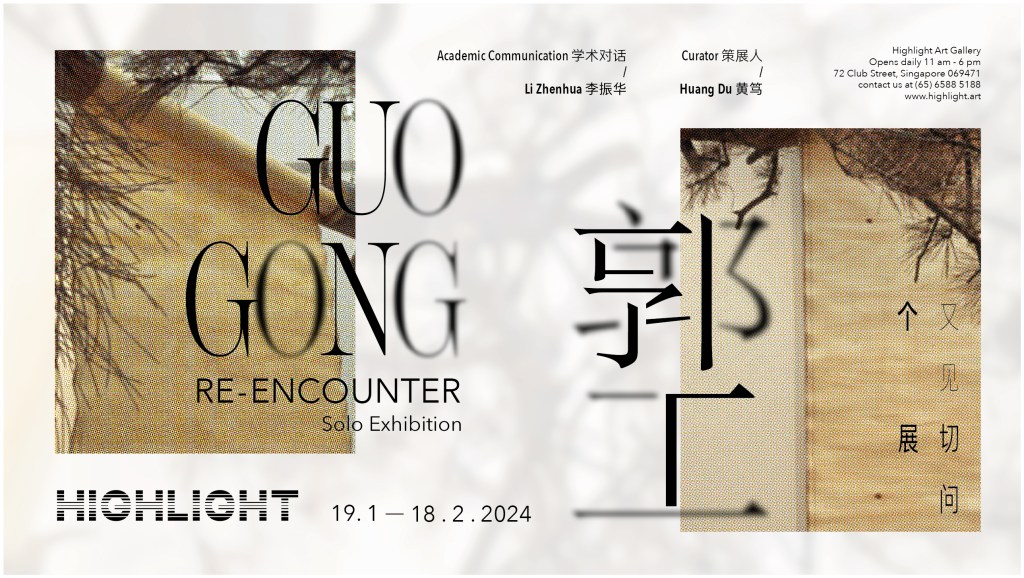
Exhibition Dates
19.1 – 18.2.2024
LOCATION
72 Club St #01-01
Xu Sheng bringing materials into the relation characterized by pure inter-enhancement; secondly, he transcends the bondage of “conception” by turning pure concepts and sociological or anthropological criticalness into the emphasis on human’s holistic perceptive system, incorporating lyrical poetry on the basis of perception instead of on aesthetic tastes.
“Interpretations of society, politics, history and other cultural connotation are among the topics frequently revisited by contemporary installation arts. Underlying such interpretations are the fundamental logics of instrumental rationalism that instrumentalizes art in the name of rationality. Guo Gong’s artistic creation is humanistic and exactly opposed to such instrumentalization. Characterized by “truthfulness” at a higher level, his works reject any attempt in theorization under any existing frameworks as genuine artistic creation derives from innovative thinking rather than conformation to existing theories. It is in this sense that Guo Gong belongs to a rare breed of artists in possession of the power in creating thoughts rather than in following trends.
While it remains unclear as to how many people are perceiving the changes of the times during the second decade of the 21st century, it is apparent that each and every generation, with few exceptions, experiences changes of some sort. Changes as such generate “Xiao Xi”, which can be roughly interpreted as “news”, be it good or bad. Xiao Xi comes from the alternation between and combination of Yin and Yang under the heaven (as it is defined in I-Ching that, the departure of Yang and arrival of Yin is termed as “Xiao”, while the inverse is “Xi”). “Xiao Xi”, invariably comes from afar, yet seems very close to its recipients. It originates from yet transcends reality. If contemporary art can also be regarded as a type of “Xiao Xi”, a reflection of the spirit of the time, Guo Gong is undoubtedly my favorite good Xiao Xi. As I enjoy viewing his works and chatting with him, I would be honored again to write about him.
As an installation artist, Guo Gong has produced a wide array of works featuring a broad range of materials. Disdaining concepts or ideologies like “spiritual practice”, “Zen-ism” “self-reproduction” and “symbolic politics” as the pretext for repetition, his “heart” is yearning for communication and exchange with this vibrant world. Not overprotecting or overexerting himself, Guo Gong chooses to experience and pursue the richness and variety of the Nature through the artistic practices where he invariably ventures into uncharted territories, encountering with unpredictable technical challenges—an integral part of his art-making. The arts made after the post-modernist context are supposed to be like this.
During the years when Guo Gong was working on his “Counting Down”, “The Scripture of Heart” and “White Light”, Anish Kapoor’s works displayed in 798 Art District sparked continuous discussions on “thrilling”, which however, ended up nowhere as theories often lagged behind practices. It was during those years that Guo Gong successfully embodied in his works his insight into installation art. To him, the top priority to creation of this artistic form is not future-oriented innovation but backward tracing— in an effort to transcend the starting point created by Marcel Duchamp until the very origin of art is reached. Therefore, he turns “appropriation” into “creation”, bringing materials into the relation characterized by pure inter-enhancement; secondly, he transcends the bondage of “conception” by turning pure concepts and sociological or anthropological criticalness into the emphasis on human’s holistic perceptive system, incorporating lyrical poetry on the basis of perception instead of on aesthetic tastes.
“Interpretations of society, politics, history and other cultural connotation are among the topics frequently revisited by contemporary installation arts. Underlying such interpretations are the fundamental logics of instrumental rationalism that instrumentalizes art in the name of rationality. Guo Gong’s artistic creation is humanistic and exactly opposed to such instrumentalization. Characterized by “truthfulness” at a higher level, his works reject any attempt in theorization under any existing frameworks as genuine artistic creation derives from innovative thinking rather than conformation to existing theories. It is in this sense that Guo Gong belongs to a rare breed of artists in possession of the power in creating thoughts rather than in following trends.
Guo Gong is convinced that “things” refer not only to materials or objects but also ideologies and thoughts. Guo Gong is convinced that He is also convinced of the commonality between humanity and the nature of things. It is through experiences with the things that the human race recovers their spirituality. He is so convinced because he has seen the spirituality of things, felt from material the messages from the creator, heard the conversations between souls and materials and experienced the moment of quivering when the beauty of the Nature unfolds before his eyes… The sufferings and miracles he went through and was immersed in can not to be shared thoroughly but the works he left behind would probably awaken the inner world of those with similar experiences in viewing the world from different perspectives.
“Pine”, Guo Gong’s representative work, resulted from destruction. While Jacques Lacan’s theories are still subject to discussion, he characterized such destruction in an accurate yet poetic statement: the genuine connection between humanity and things is built upon destruction. “The genuine connection” as such is no more than the link between the human dispositions and the nature of things or the consistency between the heart and the things. “Destruction” herein can be regarded as incursion into or possession of physical properties at certain levels, which represent a different approach to something similar to experiential perception that ultimately leads to the congruence between the physical and the mental. Therefore, this work demonstrates a holistic and purely physical coldness visible via contemporary means while embodying the dignity of life which, visible from natural perspectives, is unveiled only after things sustain injury. That is when interpretation and philosophy stay far away from works of art. Indeed, why must a piece of art work be subject to “interpretation” and why should it be interpreted philosophically? What else could “interpretation” and “philosophy” offer to art and artistic creation except the humiliation of being surrendered to “language” and of being subjected to the approval and recognition of philosophy?
This work naturally reminds its audience of the “Natural History” series created by Damien Hirst, particularly the renowned work entitled “The Physical Impossibility of Death in the Mind of Someone Living”. Marlene Dumas, a contemporary painter once characterized being too far away from the specificity of life as a kind of sin in his comment on his artistic creation. These two artists, like Guo Gong, are closely associated with the specificity of life. Just as Dumas regards paints on canvases as skin of portraits, Hirst once measured the breadth of life’s expansion through “things”, which is exactly what “Ge Wu” (investigating the way of things) in ancient China emphasizes. To categorize such breadth in the expansion of life, if the term “harmony between humanity and heaven” sounds exaggerating, “feel and then get to know the world” could be appropriate. If Guo Gong’s works are associated with the so-called “Chinese tradition”, he, like the two aforesaid artists, is much closer to that tradition than those artists who interpret themselves with “Chinese tradition”. Or in fact, tradition is not there to them because they exist in eternality at higher levels. Just as I-Ching teaches, tradition, like eternality, is in constant changes. As such, the fixed idea of “East and West dichotomy” is nothing more than a pseudo- proposition.
“The Portrait of Rebar”, a work based upon “compliance”, features the genuine visage of rebars in dilapidated buildings. Essentially, such depiction is based no longer on the grand rules of the Nature but on specific contemporary social and historic narrations, resulting in a sharp incompatibility between the beauty of lines highlighted in the work and the critical narration evoked by the material itself. The fluent and yet restrained spaces built by merely several lines, on the other hand, tend to lure the eyes of its audience into its forms. Just as the name of the work “The Portrait of Rebar” suggests, this work of art conveys a genuinely honest attitude, where the word “Portrait” alone indicates a positive expression of spirituality. Therefore, it is unlikely to be interpreted as an irony. Such positive interpretation of the work is consistent with its audience’s initial association: We always search for truth, kindness and beauty in ruins, in a world too dilapidated to make us utter these three words.
The work “1/2 of Wooden Beams” is inspired by a leaf picked up casually from the ground by Guo Gong. The leaf has its both ends curling towards the middle, a typical shape of the termination of life which however encompasses the full life massages of the tree. The tiny structure of the leaf, magnified in the work, joins another half of the beam—the base of this piece, to render the life of the tree drained of its life. The work is more like a sculpture in terms of its formal language because each and every microscopic detail of the leaf, including the veins and the sense of rhythm of its growth, have been vividly and realistically “represented”. What an arena to show Guo Gong’s commendable expertise in sculpting. To Guo Gong’s practice, it may indicate that the transient perception needs to be affirmed. If all will become empty eventually, it would be due only to man’s lack of courage to learn to appreciate a fleeting moment.
The making of “Boards”, is a practice that depends on and follows the objects themselves and their essences. Through the slow manual incision into the trunk along the internal texture, Guo Gong unveils the longitudinal trajectory of growth for each annual ring, and such a way of presentation is very different from the conventional presentation of transverse sections. Seemingly “following or compliance” appear to be easier than “destruction”, that is, adapting to certain “truth” or approaching the rules of the “truth” may seem simpler than the “destruction” in common sense, such adaptations actually requires higher levels of precision, caution and efforts. The same is true with art itself where the potential “truth”, hidden in hard-earned but insignificant trivia, maintains its consistent and noble silence.
That is where Guo Gong’s works distance themselves from Mono-ha—the art school that emphasizes only the affirmation of the nature of things and creates with the stylized approaches the process and methodology that affirm thing’s nature. Guo Gong’s works, however, take a path less travelled. Having proceeded from the nature of things, the artist constantly creates and innovates the ways of interacting between the heart and things. Such an approach has opened a new gateway for advances of contemporary art and has created a fulcrum for the dwelling of any individual.
It is the fulcrum that marks a real start of Guo Gong’s free conversation with the world. Such free conversation is typified by his work “Stainless Steel”, where the cross-section of the stainless steel sheet forms a plane which is not extremely flat but retains the errors of manual work, transforming the plain into a mirror surface. This piece can hardly be regarded as a work of art as its shape is probably beyond the wildest imagination of the audience who have seen numerous shapes of contemporary art. It appears to have been stripped down to a mere device, no longer an artistic installation with a sense of space-time (in Chinese, the equivalence of both “device” and “installation” are the same word). Devoid of quotations, cultural identities as well as aesthetic, historic or social symbols, the work is also characterized by a sense of industry which is restrained and impotently expressive. When viewed from a distance or sideways, the work can be mistaken for some simplistic, technically and creatively inadequate mechanical device. Its complete silence converts it into a subject that can never be truly seen by the audience.
Only when the audience see their own reflections and continuously perceive certain abnormality upon standing before the specific reflector will the work be truly visible. Such perception derives more from the inner worlds of the viewers than from the holistic form of the work. In other words, the audience find their own “heart”, a discovery that tends to induce tension or even tremble. Such perception stems from the discovery of the part of inner “self” which however does not belong to or is not familiar to the “self”. In this sense, it is from concealing our own secret that this work derives its heavy silence and hidden sense of deterrence.
Through complete elimination of logical interpretation and revelation of logic-free instinct as the very root of logics itself, this work, as an independent individual and as integration of its material, has transformed into a comprehensive and integrated nature of material, thereby acquiring some sort of “initiative”. Here the thing’s initiative and its capability to awaken man’s spirituality have become evident. Simply put, Guo Gong created, as essentially part of the varied world at large, a sort of life which has found its expression in his works. Such a life, while apparently strange, is in fact ubiquitous, like a poem composed by some unknown poet and passed down unconsciously from generation to generation. All the celestial objects or natural phenomena that come and go, from the sun, the moon and stars to wind, frost, rain and snow, are ebbs and rises of Yin and Yang, and traces left behind by the Nature and the spirits beyond. All the above cannot be registered by eyes but can be confirmed by logics and perceived by heart. Guo Gong’s works have become part of the circulating sequence under the heaven as he models on the traces of the Nature and converts materials left behind by the Nature into works of art before returning the works back to it. Guo Gong is always there in things—the nature of time.
 Highlight Art